
For Your Industry
Everything You Need to Know About Nurse Self Scheduling

An overburdened nursing department kills your nurses’ work-life balance. That leads to burnout and compromised patient care. Nurse self scheduling and workforce flexibility holds the key to preventing all that.
87% of nurses consider self scheduling the best solution for creating a flexible workplace.
Nurses, nurse managers, and healthcare executives agree that more flexibility at work is essential. Scheduling nurse shifts is hard without the proper technology, though. That’s where employee scheduling software comes in.
Here are a few key things to know about nurse self scheduling:
- It’s great for finding and retaining the best nursing staff, reducing absenteeism, and providing safer patient care.
- By lowering overtime, nurse self scheduling decreases your facility’s labor costs.
- A clear policy with a well-defined process and ongoing support is key.
- Employee scheduling software enforces rules to ensure enough shift coverage.
- Automated scheduling makes nurse self scheduling faster and easier.
Table of contents:
What is nurse self scheduling?
Self scheduling for nurses lets nurses choose the shifts they’ll work within a given scheduling period.
Some constraints apply to this practice, though, to ensure quality patient care. Nurse self scheduling is an employer-employee work arrangement. It supports both your organization’s needs and the individual’s schedule preference.
Self scheduling is a type of flexible work that improves nurses’ work-life balance at hospitals and clinics. It helps them avoid burnout. Nurse self scheduling lowers nurses’ absenteeism and increases retention. It also frees up your time so you can do other tasks.
How does nurse self scheduling work?
In self scheduling for nurses, you don’t assign shifts. Instead, nurses pick up available shifts from a list in employee scheduling software.
Although nurses choose the shifts they want to work, you can still review the schedule to make there are no coverage or skill gaps.
You should also put resources toward training nurses to use the technology and follow the defined rules. Communication channels with team messaging capabilities are excellent for further, ongoing support.
What if nobody self schedules for a specific shift?
Not getting enough shift coverage is every nurse manager’s nightmare. But you can reduce that risk by defining rules to ensure the desired coverage. Using employee scheduling software that puts those rules into practice is also helpful.
Consider starting with putting up a few shifts for self scheduling. And over time, you can allow nurses to self schedule all shifts. This way, you can ease into the process without causing a drastic change.
Pros of nurse self scheduling
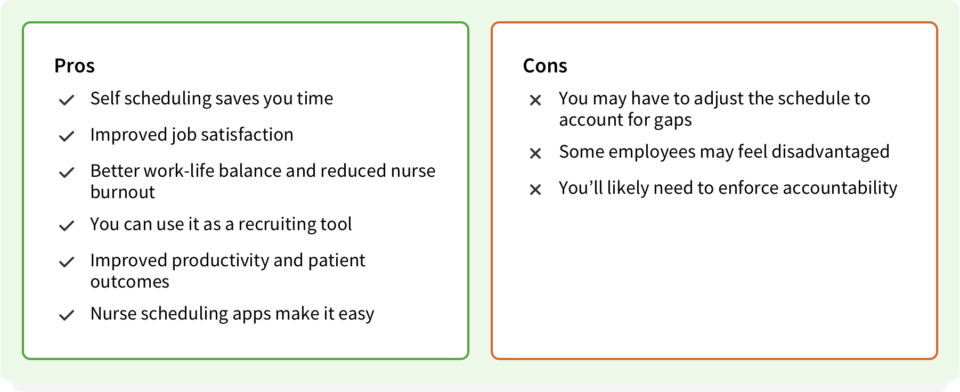
Nurse self scheduling has a lot going for it, including:
- Saving you time on scheduling
- Increasing job satisfaction
- Reducing burnout and turnover
- Better retention
- Improved patient outcomes
Self scheduling saves you time
Scheduling nurse shifts is complex and time-consuming. In hospitals and other inpatient or long-term care facilities, the nursing job is often 24/7. That means that your schedule must account for all hours of the day. Then, you need to account for skill sets per shift, workload distribution, and time-off without compromising patient care.
With self scheduling, you don’t need to decide who works which shifts. That’s because your staff selects their schedule for you. Plus, employee scheduling software, can save you up to 15 hours per week building the schedule.
Improved job satisfaction
When nurses can choose their own schedules, they may find themselves happier at work. They have more autonomy and are recognized as professionals who can manage their own work hours. In turn, you keep them and reduce absenteeism.
Some nurses focus more on spending time with their families. Some prefer working more days in a row before taking time off. Others need to take more time off between shifts to rest physically and mentally. And some prefer taking days off on specific days of the week.
With self scheduling, nurses work the shifts they prefer. The flexibility builds a happy nursing workforce that’s engaged with their job, peers, leaders, and patients.
Better work-life balance and reduced nurse burnout
In nurse self scheduling, nurses choose shifts in advance, so they can plan around their personal lives. That’s a work-life balance that can reduce stress levels and avoid burnout.
You see, nurse burnout can create a vicious cycle. For example, chronically-stressed nurses might need to retire early. Younger nurses may give up the profession altogether to seek better work-life balance. Registered nurse turnover is 17.1%, costing hospitals in the U.S. $4.2-6.2 million each year.
When so many nurses leave, others may have to work overtime to make up for understaffing. This harms their work-life balance and eventually puts them at risk of burnout, too.
You can beat the cycle with nurse self scheduling. By giving nurses agency over their schedules, they can focus on their needs.
You can use it as a recruiting tool
Offering autonomy to your staff shows you’re committed to their work-life balance. And that’s one of the underpins of a healthy work environment. Plus, they’ll feel psychologically safe, which helps them face any challenge at work. You can use this perk in your job postings, your website’s career section, and more.
Improved productivity and patient outcomes
By picking up the shifts they work best in, you make their job less stressful. Plus, you create a healthier work environment. And that is key to providing the best patient care.
For instance, nurses can choose shifts according to their energy levels. This means nurses who are more energetic in the morning can pick up morning shifts. Those with more energy in the afternoon can select afternoon shifts instead.
A higher nurse-to-patient ratio makes patient care safer and more individualized. That’s possible because self scheduling reduces absenteeism and increases employee retention.
Finally, self scheduling for nurses makes nurse management more efficient. That frees up time for patient care.
Nurse scheduling apps make it easy
A nurse staff scheduling software solution like When I Work reduces labor costs by lowering overtime from turnover. It also makes the process faster and more efficient.
When a nurse calls in sick or doesn’t show up for work, you can open a last-minute shift in the platform right away. Nurses can see open shifts in real time, and they can pick up that shift in a matter of minutes.
On top of that, self scheduling tools with automatic scheduling capabilities save everyone’s time. Those tools also offer online schedule access to nurses. This eliminates the need for nurse managers to discuss or make the changes every time nurses need to adjust their schedules.
Did you know? The labor forecasting feature within When I Work helps you collect data to adjust staffing levels according to the anticipated demand. Try it for free today to see how it can help you staff your nurse workforce.
Cons of self scheduling for nurses
There are always a few things to look out for when it comes to staffing and self scheduling, including:
- Coverage gaps for undesirable shifts
- Favoritism
- Accountability
You may have to adjust the schedule to account for gaps
Once nurses choose the shifts they want to work, you might have some empty slots in the schedule. There are a few solutions to this. Instead of hiring initiatives and calling people in, you could offer those shifts to travel nurses who work on temporary assignments or to a pool of per-diem nurses who work on an as-needed basis.
Some employees may feel disadvantaged
The nurse self scheduling process must be fair and equitable. But some nurses might fear favoritism of other nurses’ preferences over theirs. That’s why it’s so important to involve them in creating the self scheduling process and rules. Transparency is the only way they’ll buy in, own, and follow it.
You’ll likely need to enforce accountability
It’s great that you trust your nurses’ sense of responsibility to handle self scheduling. It means you won’t micromanage them. But it’s always a good idea to put the mechanisms in place to enforce accountability for shift coverage. You can do it with a well-defined self scheduling policy, continuous communication and support, plus the right technology.
Common nurse self scheduling models
To create a flexible work environment that balances employee autonomy with patient care, most healthcare facilities use one of the following approaches:
Preference-based scheduling
Nurses submit their preferred shifts and days off before the schedule is built. A nurse manager reviews these requests and creates a schedule using that input, while also filling in any remaining coverage gaps.
Cyclical self scheduling
Nurses choose a repeating base pattern of shifts. The core schedule remains fixed, but nurses use employee scheduling software to easily swap shifts or trade off days with qualified peers as personal needs arise.
Hybrid self scheduling
The scheduling period is broken down into tiers. Highly-requested shifts, weekends, and holidays are distributed first based on a set of rules (like seniority or rotations). Then, the remaining shifts are opened up for nurses to grab when they want to work.
Fully-open self scheduling
This is the most autonomous model, where no shifts are assigned. The schedule is released blank, with all open shifts, and nurses have complete freedom to sign up for whatever shifts they want on a first-come, first-served basis.
How to get started with self scheduling for nurses
Although nurse self scheduling has many benefits, it isn’t easy to put into practice. Here are the steps to get you started:
Determine your staffing needs
You must find the balance between patient needs and workforce flexibility. This means offering self scheduling . But you also have to maintain a nurse-to-patient ratio that’s good enough for quality patient care. And it has to be efficient, too.
You have to determine whether you’ll work with full-time or part-time schedules. You must also account for the staff’s days off and your staffing needs over weekends, holidays, and nights.

Brainstorm some ground rules for your self scheduling
Whereas some nurses might try to work too many shifts, others might attempt not to work enough shifts. And it’s up to you to prevent both situations, which could result in understaffed periods or burned-out personnel.
You must also prevent conflicts over preferred shifts or disparities in shift distribution. For instance, you must establish the kinds of shifts you’ll have and the eligibility criteria for the nurses who can get each kind. You must also define the criteria to figure out who gets priority over a highly-requested shift.
For example, you can determine how many weekend shifts or bank holiday shifts each nurse or nurse category can work per month. You could also create rules based on seniority.
Listen to your nurses’ concerns, and based on what you already know about their work habits, set up self scheduling rules.
Create your self scheduling policy
A nurse self scheduling policy is a set of guidelines to govern that process. Apart from nurse-to-patient ratios and other legal regulations, your guidelines might dictate that:
- You’ll have rotating schedules with a certain configuration.
- A nurse manager will review the schedule for each scheduling period after nurses finish self scheduling their shifts.
- Nurses will have enough time to self schedule shifts and enough options available to choose from.
- The self scheduling tool must be user friendly and accessible to everyone involved in the process.
- Each shift will have nurses with the necessary skill set.
- The self scheduling process will follow labor laws, rest hour regulations, and collective bargaining agreements.
- You’ll use a time clock to track shift attendance and verify staff’s accountability for self scheduled hours.
- Nurses must follow certain procedures to request time off and specific overtime rules.
Once you define your self scheduling policy for nurses, communicate it clearly and promptly to your personnel.
Choose a nurse self scheduling software
The platforms that support nurse self scheduling help you avoid conflicts over shift preferences and workload distribution. For example, When I Work allows mobile and 24/7 access, real-time visibility of available shifts, shift swapping, time-off requests, labor cost insights, payroll management, and more.
You must train your nurses to use your chosen software effectively. Then, you must provide ongoing support through a messaging app, a knowledge base, and other educational resources like FAQs and tutorials.
Set a self scheduling trial run
It’s a good practice to test your nurse self scheduling process with the software you chose to implement it.
If you’re managing nurses at a clinic, you might wish to do that over a scheduling period that’s usually slow and low on the number of patients. But if you’re the nurse manager at a hospital, it’s a good idea to confine the trial run to a small unit first. Then, if the process goes smoothly, you can expand it to other units within the hospital and, finally, to peak periods.
Even so, a schedule reviewer should always be on standby to resolve any conflicts that might come up during the trial run. And make sure that support channels are open in case the staff needs help.
Use scheduling data to refine your approach
Depending on the results of your trial run, you might need to change your nurse self scheduling process, policy, and software configuration. Define key performance indicators and analyze scheduling data against those indicators after the trial run to pinpoint any needs for improvement.
How to prevent nurse self scheduling issues
Using employee scheduling software is a great option to track scheduling trends, labor costs, and conflicts. This helps you uphold your self scheduling rules.
When I Work allows you to customize scheduling rules that prevent conflicts or disparities. And apart from labor forecasting, it gives you real-time visibility of available shifts, staffing levels, and the distribution of work hours.
This minimizes the odds of unfair workload distribution, over- or understaffing, and a low patient-to-nurse ratio. It also enables you to take immediate measures to enforce compliance with legal requirements and ensure patient care safety.
When I Work is your go-to solution for nurse scheduling software.
Explore self scheduling solutions for your nurse staff with When I Work
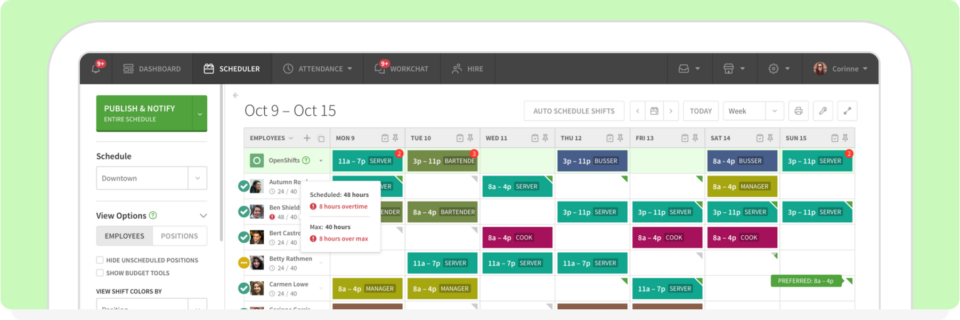
When I Work is a nurse self scheduling platform that helps you create the flexible work environment your staff needs. It’s also the software that guarantees the right nurses will be at work at the right time to provide quality patient care.
Sign up for a free trial of When I Work and start saving time while ensuring shift coverage at your healthcare facility.
Nurse self scheduling FAQs
Q: What is self scheduling nursing?
A: Nurse self scheduling is the practice of letting nurses choose the specific dates and times they prefer to work from a provided list of available shifts during any given scheduling period.
Q: Can nurses choose their own schedule?
A: Yes, nurses can choose their own schedule by picking up available shifts through an employee scheduling software like When I Work. Employers can set up rules to ensure adequate coverage and proper patient care.
Q: Does self scheduling increase job satisfaction?
A: Yes, self scheduling empowers nurses to choose their own hours. That boosts autonomy, recognizes them as valued professionals, and lets them build work-life balance.
Q: How to do scheduling for nurses?
A: Nurse scheduling is done by deciding on your facility’s staffing and patient needs. You should create a clear self scheduling policy to prevent conflicts. You can make it easier by using an automated employee scheduling software to manage coverage.