7 Best Practices For An Effective Employee Performance Review
 by
byTry When I Work for free

Gain a comprehensive understanding of an effective employee performance review process. Explore its significance, best practices, and the potential impacts these reviews can have on both employees and the overall workplace.
Equip yourself with strategies to make performance reviews more effective and beneficial for all involved.
| Try When I Work free for 14 days, no credit card required! Sign up now |
Key takeaways
- Employee performance reviews are formal assessments that foster open communication between managers and team members, aiming to improve future work performance.
- Preparing in advance, using tactful communication, providing concrete examples, and adopting a 360-degree feedback system are essential best practices for effective reviews.
- Performance reviews should be an ongoing process, allowing for timely feedback and adjustments, rather than being limited to annual evaluations.
- It’s crucial to track the impact of reviews to ensure they lead to positive outcomes and contribute to professional development.
- The employee handbook should clearly outline performance expectations and the review process to reduce uncertainties and ensure transparency.
What is an employee performance review?
An employee performance review is a formal assessment of an employee’s work performance. These reviews help foster open communication between managers and team members about performance and may help improve employees’ work going forward.

Why effective employee performance reviews matter
Effective employee performance reviews matter because they serve as a bridge between your company’s goals and your team member’s individual growth. It’s important to provide a clear, structured place for honest, two-way communication to clarify expectations and align on future behaviors.
When handled correctly, they can identify skill gaps, high-potential employees, and opportunities for promotions and compensation adjustments. Reviews also create a culture of accountability and ensure employees feel seen, valued, and motivated.
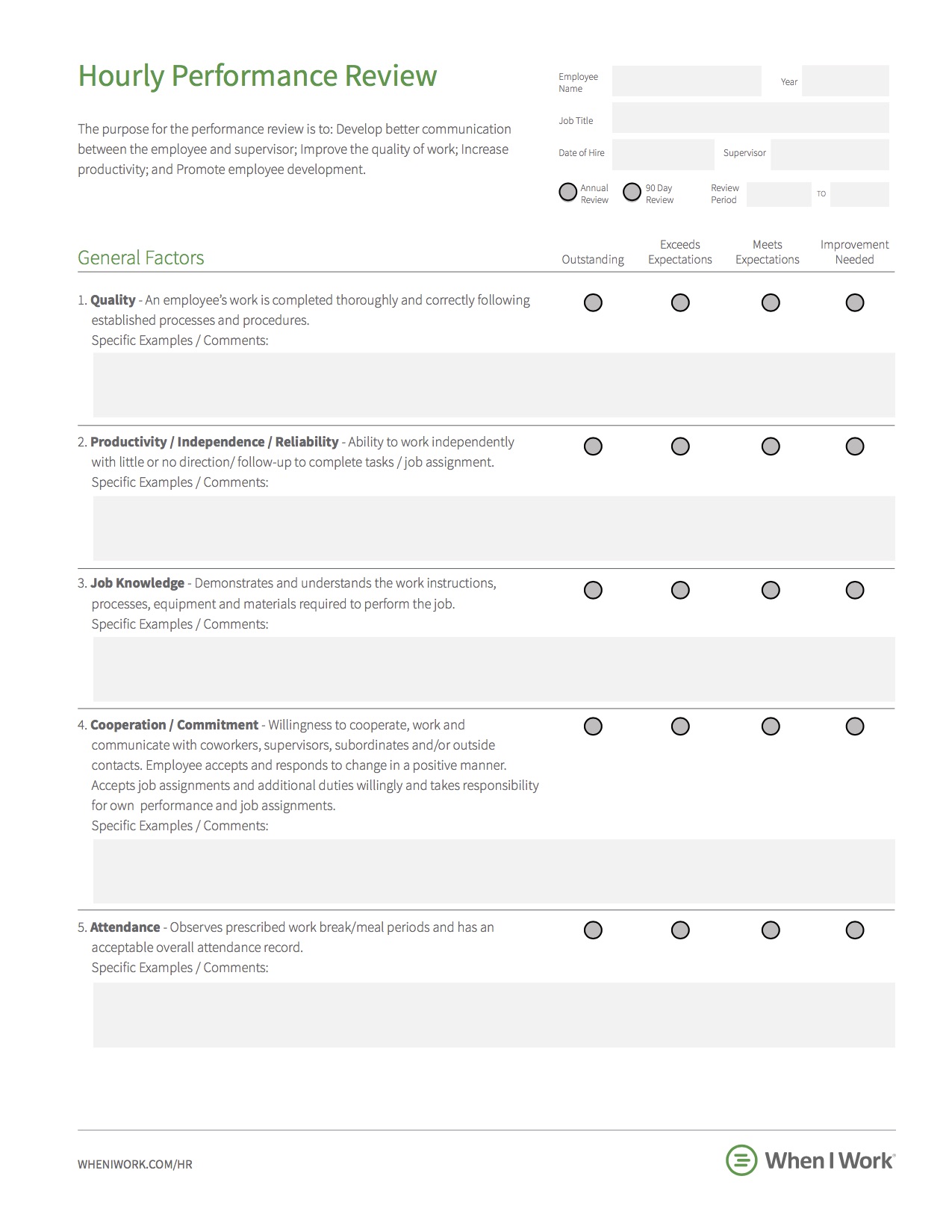
Need a form to perform a performance review of your hourly employees? Download this employee performance review template for free.
Related read: The Complete Guide To Human Resources For Small Businesses
7 best practices for an effective employee performance review
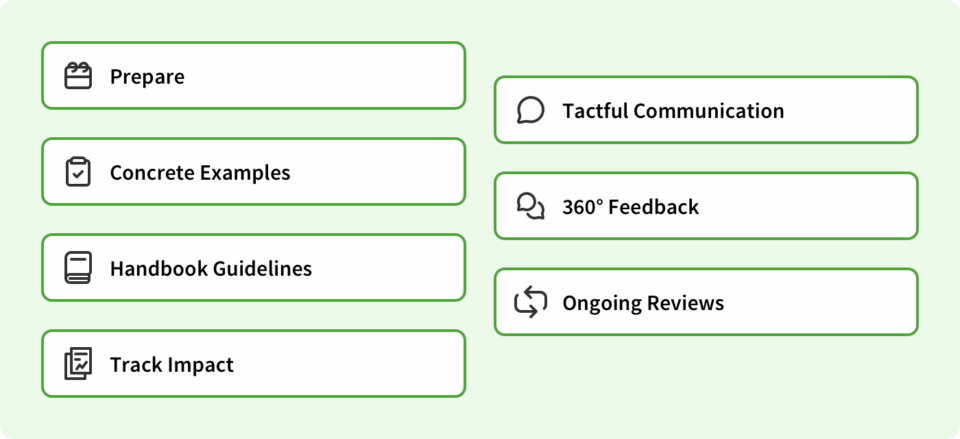
So how do managers go about these assessments? Try these 7 tips to help you conduct an effective employee performance review:
1. Prepare beforehand
If you can plan ahead for an employee performance review, it means you have a system and process you take seriously.
Planning ahead for the review might include:
- Documentation—that includes a copy of the employee’s personnel file, notes from previous reviews, the goals and objectives you and the employee discussed at the last review, and any forms or reports you need to fill out.
- Feedback—you’ve spoken with any supervisors or coworkers according to your review process, and have that information handy.
- Examples—you have copies of recommendations (or complaints) from managers, coworkers, or customers.
- Performance data—including sales or productivity goals relevant to the type of review you are conducting.
- Questions—you’ve gone over all data, comments, and documentation and made notes of possible questions to ask.
- Schedule—you’ve told the employee the date and time of the review, giving them adequate time to prepare.
- Prework—you’ve given the employee forms or questions to think about ahead of time based on what your review process allows for.
- Agenda—you’ve alerted them to whether or not you expect them to also review management, so they can think about it ahead of time.
Note: Performance reviews should be planned separate from promotion/pay increase conversations.
When an employee thinks the conversation about their performance will affect their pay, they may speak more cautiously and avoid sharing potentially beneficial information in order to protect themselves.
Consider a performance review a place to encourage professional development, and create a separate review for promotions and pay increases, even if the latter is held just a few days later.
2. Communicate with tact
Before you sit down with any employee, go in prepared to use thoughtful communication that will build up your employee, not tear them down.
Performance reviews should avoid swaying all negative or all positive. Being overcritical will likely demotivate the employee; but on the other hand, there’s almost always something that could be improved.
Tactfully sharing positive attributes alongside the items that need work will help the conversation feel more balanced, and ensure your employees don’t feel attacked.
Note: In general, anyone conducting employee performance reviews should have experience or knowledge of diversity training.
If your company has a diversity training program, your reviewer should definitely participate. Hopefully, the different ways cultures and people work and communicate are part of this training so that a reviewer can understand each employee’s background.
3. Provide concrete examples
Have examples prepared for both achievements and areas of improvement and share them throughout the review.
Being able to cite specific instances of behavior to employees proves you’ve truly done your homework as a manager.
This type of communication is much more effective than simply saying what your team member has done right or wrong. It shows you’ve been paying attention and gives your feedback more credibility.

Performance review example: What good feedback looks like
Here’s an example of what good feedback looks like on a performance review: In the last six months, employee has consistently exceeded the goals in their role as shift lead. They have reduced end-of-day closing time by 15% through a new station-prep checklist. Junior staff members frequently seek them out for guidance on complex customer service issues, which has led to seven instances of positive feedback from customers where they mention you by name.
4. Try 360° feedback
360 degree feedback is where each employee receives anonymous feedback from those who work around them. This includes co-workers, managers, and anyone whose paths they might cross.

These people fill out a survey responding to questions about the performance, behavior, and competency of the employee. The employee also takes the same survey as a form of self-review.
This system offers a form of checks and balances which gives coworkers a chance to supply information about what’s happening in a way you might not be able to do. However, this method isn’t meant for measuring “hard data” items, such as job attendance or sales performance.
If your performance review tends to fixate on the measurable numbers, 360 degree feedback is an excellent way to broaden those results and discover ways your employees make your culture great, even if they aren’t standouts in the numbers game.
5. Put performance requirements in your employee handbook
Your employee handbook should be clear on how your performance review program works, and what is expected of each employee in regards to performance, attitude, attendance, sales, and so on.
This includes:
- What your review process is, and the timeline it occurs.
- What supervisors and managers expect of employees, and what employees should expect of them.
- What leads to an employee being fired instantly (e.g. theft), and if, in other cases, they’ll receive a written warning for their personnel file before the danger of being fired is real.
- Performance, attitude, teamwork, ethics, and any other benchmarks that you will cover in a review and that you expect employees to meet.
- What the end results of reviews might be (e.g. you won’t get fired, you might get a pay raise)
Clearly lay out your entire employee performance review program in the handbook, and go over it with each new hire.
For one thing, making this clear helps reduce fear and dread among employees. It also helps protect you legally, which is why you should work with your legal counsel when developing employee policies relating to firing.
6. Make performance reviews an ongoing process
Instead of annual, set reviews, employees should be given clear expectations and have regular feedback (positive and negative) with managers.
These periodic times of feedback are based around a time schedule that works best with the particular job the employee has. Is the employee working in four week shifts? Set the feedback loop at four weeks, for example.
What’s the benefit to this approach?
- You can make micro-adjustments to employee performance instead of trying to push big changes through once or twice a year.
- You find out about good (or bad) employee performance trends and capitalize on (or put an end to) them early on.
- You get a better understanding of what’s happening for all employees as it’s happening instead of making shocking discoveries the next time a perfunctory review rolls around.
- Employees work as a team instead of competing against each other.
Review cadence guidance
It’s up to you how often you do employee reviews, but most companies choose between annual reviews and an ongoing (monthly or quarterly) review process.

You can adjust your employee performance review methods to adopt a progressive and continual approach that is punctuated with a periodic standard “full” review. This makes the review less jarring for everyone involved.
7. Track the impact of reviews
Look back on your goals you established for each of your employee performance reviews. Ask yourself:
- Does performance get better afterwards, or is it hampered?
- Do employees seem more confident, or are they hesitant?
- Has morale increased or decreased?
- Are the changes you suggested for improvement happening in a positive way, or at all?
- Do you notice employees quitting their jobs at a greater rate after reviews?
- Are your employees more productive or less after the review cycle?
- How do your employee engagement scores compare from before and after reviews?
Step-by-step performance review summary
When you’re ready to start your performance review cycle, be sure to follow the steps in order so you can complete the cycle with the best results
Preparation → Conversation → Follow up
Related read: How To Deliver Uncomfortable Employee Feedback
Save more time every week so you can focus on developing your employees. Start your free trial of When I Work today!
Common mistakes to avoid
If the results of your employee performance reviews leave things worse than when you found them, it’s time to make a change to your review process.
Make sure your reviews are not biased, but rooted in practical examples. Be sure to avoid the all or nothing thinking as well, allowing one standout trait or mistake to color everything an employee has done during the review period.
Employee performance reviews aren’t there to weed out “bad” employees.
Instead, reviews are critical to determining salary or wage increases, promotions, needed correction, and an overall sense of what’s happening in your workforce. By using these seven approaches to your performance program, you’ll be able to treat your employees as what they really are: your most valuable asset.
How to improve your performance review process
The first thing you want to do is make sure your process is consistent, with clear timelines that occur every year.
Also, nothing should be a surprise on your employee’s review. You should be giving feedback all year long. Don’t wait until review time to bring up something that happened months ago. Reviews are a way to manage patterns of behavior.
Finally, setting SMART goals (specific, measurable, achievable, relevant, and time-bound) is a great way to manage your employee’s performance after the review process. And now you have something to measure against when the next review cycle comes around.
| Start your free 14-day trial of When I Work today! Sign up now |
Employee performance review FAQs
What is an employee performance review?
An employee performance review is a formal assessment of an employee’s work performance, aiming to foster open communication between managers and team members and improve future work outcomes.
Why is preparation important for conducting performance reviews?
Preparing in advance ensures that the review process is systematic and thorough. It involves having relevant documentation, notes from previous reviews, performance data, and feedback from coworkers, which helps in providing a comprehensive evaluation.
How can communication be made more effective during a performance review?
Using tactful communication that balances positive attributes with areas needing improvement helps in making the conversation constructive. It’s essential to avoid being overly critical or overly positive to ensure the employee receives a well-rounded assessment.
What is 360 degree feedback in the context of performance reviews?
360 degree feedback involves collecting anonymous feedback about an employee from those they work with, including coworkers, managers, and others. The employee also takes a self-review survey, providing a holistic view of their performance from multiple perspectives.
Why is it essential to track the impact of performance reviews?
Tracking the impact helps in understanding the effectiveness of the review process. By assessing outcomes like improved performance, employee confidence, morale, and retention rates, managers can refine the review process for better results.
Should performance reviews be linked to promotions or pay raises?
It’s recommended to keep performance reviews separate from promotion or pay increase discussions. When employees believe their performance feedback might affect their pay, they might be more cautious in their responses, potentially withholding valuable insights.
How can an employee handbook aid in the performance review process?
An employee handbook that clearly outlines performance expectations, the review process, and potential outcomes ensures transparency and reduces uncertainties. It helps employees understand what’s expected of them and the benchmarks they need to meet.
What should managers focus on during a performance review?
Managers should focus on providing concrete examples of behavior, both positive and areas needing improvement, ensuring the feedback is specific and actionable. They should also encourage professional development and use the review as an opportunity to strengthen the employee-manager relationship
How can performance reviews contribute to a positive work environment?
Performance reviews, when conducted effectively, can identify and reinforce positive behaviors, address areas of concern, and provide a platform for open communication. This can lead to improved morale, better teamwork, and a more cohesive work environment.
How often should performance reviews be done?
It’s up to you to decide the best cadence for your team. Some people like to use ongoing reviews, such as monthly or quarterly, and some businesses prefer an annual review process. The most important part is that your review process timing stays consistent to give your employees time to work through their challenges and meet their goals.
What makes a performance review effective?
The most effective employee performance reviews give your team members the ability to see how their performance impacts the company’s goals and how your employees can grow within the organization. The most useful way to do this is with SMART goals that are specific, measurable, achievable, relevant, and time-bound.
What should you not say in a performance review?
Review conversations should be objective, so you should avoid emotional examples and talk about feelings. Performance reviews are for concrete examples of patterns, so you should address the good and the bad with specific ways to add more good and navigate the undesirable performance.
Save time building the work schedule every week, so you can help your employees focus on their individual development through better performance reviews. Start your free trial of When I Work today!